The Answer Depends on the Required Mirror and the Vehicle
Missing Mirror Versus Cracked Glass Versus Cosmetic Housing Damage
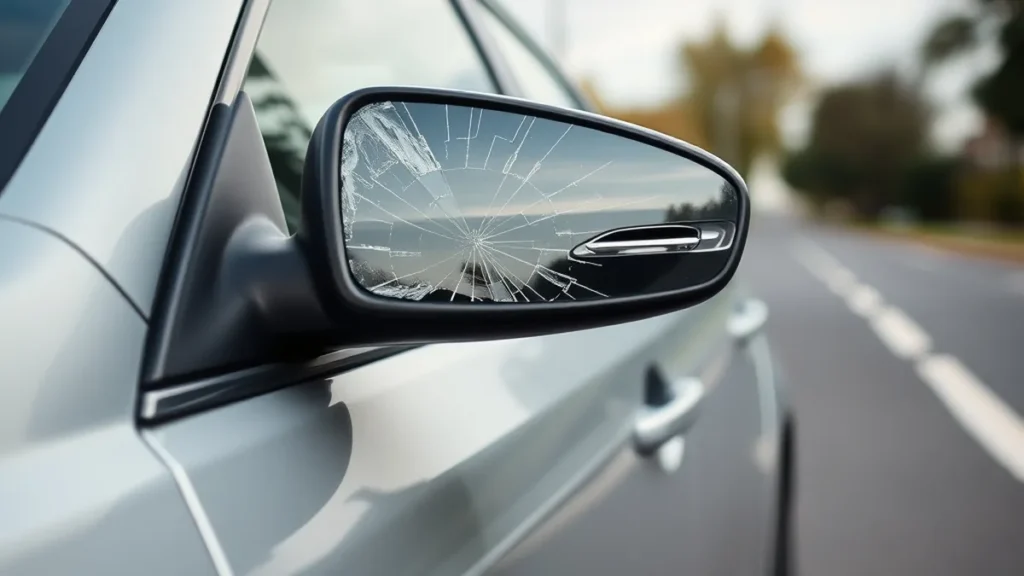
The legality of driving with a broken side mirror varies by state, registration, vehicle class, and visibility requirements. In the 19 states reviewed, a "broken" mirror can mean a missing required mirror, unusable reflective glass, or damage to the housing. Requirements differ, and not all visible cracked glass is lawful. For example, some states mandate specific mirrors based on vehicle registration or class, while others focus on ensuring a clear view of the road behind the vehicle.
In California, vehicles registered in the state, excluding motorcycles, must have at least two mirrors, including a left-side mirror. If the interior rearview mirror is obstructed due to construction, loading, or towing, both exterior mirrors must provide a 200-foot rearward view. Foreign-registered vehicles and motorcycles have separate 200-foot mirror requirements. Passenger-only obstructions do not trigger the requirement for both exterior mirrors. Additionally, certain autonomous vehicles may be exempt under federal conditions.
In Maryland, every motor vehicle must have at least one mirror providing a 200-foot rearward view. Maryland-registered vehicles also require an outside driver-side mirror for rearward and side visibility. If the interior view is obstructed, two outside mirrors are necessary. Motorcycles have a distinct requirement for mirrors on both handlebars, adhering to applicable federal standards.
In Virginia, vehicle inspection criteria specifically reject mirrors with cracked or otherwise defective reflective surfaces, implying that functionality must be maintained.
Place of Operation, Registration, and Vehicle Date
In New York, vehicles registered in the state and manufactured or assembled on or after July 1, 1967, with a model year of 1968 or later, must have an adjustable left exterior mirror. Additionally, passenger vehicles manufactured after June 30, 1969, with a model year of 1970 or later, must have an adjustable interior mirror. The general requirement is for a mirror or reflecting device that provides a clear full view of the road and traffic behind.
How State Rules Differ
Visibility-based Provisions: Arizona and Florida
In Arizona, if construction or loading obstructs the rear view, two mirrors must provide a view at least 200 feet behind. Florida requires at least one mirror showing a 200-foot view for vehicles alone or towing, without expressly mandating two exterior mirrors. Arizona's rule does not specify left or right sides but requires two mirrors under certain conditions.
Visibility-based Provisions: Maine, Minnesota, Washington
In Maine, vehicles with construction, equipment, load, or use that obstructs a clear rearward view must have a mirror or reflector providing a 200-foot view. Minnesota requires a mirror or technology reflecting or displaying the highway at least 200 feet behind if the vehicle's construction, load, or connection obstructs the rear view. Washington mandates a left mirror plus a second mirror either inside near the center or outside on the right, each showing at least 200 feet behind, and all required mirrors must be in good condition.
Selected-state comparison
How to read the table and its limits
The table compares state-specific mirror requirements, including rules based on vehicle rear-view obstruction and type.
For a comprehensive understanding, pay close attention to the following:
- Provisions for Obstructions: Many states mandate additional mirrors if the vehicle's construction, loading, or towing obscures the rear view. For instance, some states require a mirror that provides a 200-foot view to the rear under these conditions. For example, in California, vehicles with obstructed views due to construction or loading must have both exterior mirrors providing a 200-foot rearward view.
- Different Rules for Different Vehicle Types: Certain states have different mirror requirements for motorcycles compared to passenger cars or commercial vehicles. Ensure you check the specific category to which the law applies. In Florida, the statute describes a mirror and visibility requirement without specifying a universal side-mirror count.
- Scope and Exemptions: The laws sometimes specify exemptions or additional scope elements, such as whether they apply to a state-registered vehicle or in particular conditions like autonomous vehicle operation. For instance, Texas law includes exclusions for certain types of vehicles like farm machinery and bicycles unless specifically covered.
- State-Specific Configurations: While some states might require only one mirror if there is no obstruction, others may require a driver-side mirror plus at least one additional mirror.
The table does not provide penalties or fines but focuses on structural and functional requirements based on state regulations. The regulation excerpts, when present, are interpretations from verified, up-to-date official legislative resources.
| State | Reviewed requirement | Vehicle scope / limitations |
|---|---|---|
| Arizona | A.R.S. 28-956: When construction or loading obstructs the rear view, two mirrors must provide a view at least 200 feet behind. | Applies to motor vehicles within the section; fully autonomous vehicles incapable of human operation are excluded. This conditional provision alone does not prove that removing factory mirrors is lawful. |
| California | Vehicle Code 26709(a)-(d): California-registration vehicles other than motorcycles need at least two mirrors, including a left mirror. Obstructed construction/loading, obstructing towing and buses/trolley coaches trigger both exterior mirrors with 200-foot rearward views. | Foreign-registered vehicles and California-registration motorcycles have a separate 200-foot mirror rule. Passenger-only obstruction is excluded from subdivision (b). Subdivision (d) has a federally conditioned exemption for specified driverless autonomous vehicles. |
| Delaware | 21 Del. C. 4308: Motor vehicles and motorcycles need a mirror positioned so the driver can readily identify traffic overtaking in the same direction. | The section does not itself prescribe a left/right mirror count or a 200-foot distance. This short provision does not cover all applicable equipment law. |
| Florida | Florida Statutes 316.294: A vehicle, alone or towing, must have a mirror positioned to show the highway at least 200 feet behind. | This section describes a mirror and visibility, not an express universal side-mirror count. Its violation is a noncriminal nonmoving traffic infraction; no dollar fine is asserted. |
| Iowa | Iowa Code 321.437: Every motor vehicle needs a 200-foot rearward mirror view. Loading or towing that obstructs the interior view requires an unobstructed side mirror. Vans and van-type vehicles require adjustable unit-magnification outside mirrors on both sides, each at least 19.5 square inches. | The loading/towing provision also addresses retracting/removing side mirrors when not needed; the independent permanent van rule remains separate. Subsection 2 permits specified additional convex mirrors for certain vehicle-transport combinations. |
| Maine | 29-A M.R.S. 1913: A vehicle whose construction, equipment, load or use blocks a constantly clear rearward view needs a mirror/reflector giving a clear 200-foot view. Motorcycles separately require a rearview mirror with a 200-foot view. | Temporary outside mirrors must be removed or adjusted not to project beyond the automobile when operating without a trailer/semitrailer. This is not an instruction to remove required factory mirrors. |
| Maryland | Transportation 22-403(a)-(d): Every motor vehicle needs at least one mirror giving a 200-foot rearward view. Maryland-registered vehicles also need an outside driver-side mirror with rearward and side visibility. Obstructed interior views require two outside mirrors. | Motorcycles follow subsection(c), requiring right- and left-handlebar mirrors meeting applicable federal standards, rather than the subsection(b) driver-side rule. |
| Minnesota | Minn. Stat. 169.70: Motor vehicles whose construction, load or connection to another vehicle obstructs the rear view need a mirror or other technology reflecting/displaying the highway at least 200 feet behind. | The express technology wording is state-specific; this does not establish a nationwide camera substitution rule. |
| North Carolina | G.S. 20-126(a)-(c): An approved interior mirror generally supplies a clear, undistorted, reasonably unobstructed rearward view; an approved alternative is allowed when construction/loading makes it ineffective. Covered in-state registered vehicles made/assembled/first sold on or after 1966-01-01 need a driver-side outside mirror. | Approved outside-mirror pickup trucks are excepted from the interior requirement. Listed farm, construction and registration-exempt vehicles are exempt under subsection(a). Motorcycles have a separate clear 200-foot mirror rule. The section expressly limits negligence-per-se treatment. |
| North Dakota | N.D.C.C. 39-21-38; 39-21-39(4): Since 1964-01-01, motor vehicles alone or towing need a mirror showing at least 200 feet behind. Section39-21-39(4) allows its rear-window tint exception when outside mirrors on both sides satisfy section39-21-38. | The basic one-mirror provision is separate from conditional two-outside-mirror requirements or general window obstruction rules. |
| New York | VTL 375(10), (10-a): General rule: a mirror/reflecting device adjusted for a clear full view of rearward road and traffic. New York-registered vehicles manufactured/assembled on or after 1967-07-01 and designated model1968 or later also need an adjustable left exterior mirror. | Covered in-state passenger vehicles made after 1969-06-30 and model1970 onward have an adjustable-interior-mirror rule. Covered in-state buses with capacity10+ made after 1970-07-01 have an additional right-mirror rule. Specific delivery/refuse vehicles have additional reversing-device provisions. This provision does not establish a universal 200-foot requirement. |
| Ohio | Ohio Rev. Code 4513.23: Motor vehicles, motorcycles and trackless trolleys need a rearview mirror. The provision separately requires specified operators to maintain clear forward/side visibility and a clear rear view by mirror. | It does not state a universal 200-foot mirror distance or two-exterior-mirror count. A violation is a minor misdemeanor; no fine amount is asserted. |
| Pennsylvania | 75 Pa.C.S. 4534: A motor vehicle or combination on a highway needs at least one mirror or similar device providing an unobstructed rearward highway view. | The section exempts special mobile equipment and commercial/other implements of husbandry not originally equipped by the manufacturer. Inspection regulations can impose additional class-specific conditions; the statute alone is not an inspection pass. |
| Rhode Island | R.I. Gen. Laws 31-23-15: Obstructed-construction/load vehicles need a 200-foot rear-view mirror. Vehicles primarily carrying passengers must have a mirror on the left front door or fender giving a 200-foot rearward view. | The passenger-vehicle rule is additional to the conditional obstruction provision. The section cross-refers to a fine schedule; no specific dollar amount is stated here. |
| South Carolina | S.C. Code 56-5-4990; 56-5-5015(D)(1): A motor vehicle whose construction/loading blocks the rearward view needs a mirror showing at least 200 feet behind. A sunscreening device on the rearmost window triggers right and left outside mirrors under section56-5-5015(D)(1). | The separate tint, visibility and other equipment requirements also apply. |
| Texas | Transportation Code 547.602; 547.002; 547.004; 547.618: Motor vehicles, including towing vehicles, need a mirror showing the highway at least 200 feet behind. Section547.004 separately addresses unsafe equipment; satisfying the short mirror-count rule is not a complete safe-operation determination. | Section547.002 lists farm/road machinery, bicycle, golf-cart, neighborhood-electric and off-highway exclusions unless specifically covered. Section547.618 concerns equipment irrelevant to exclusively automated driving. No blanket passenger-car side-mirror exemption or guaranteed ticket dismissal is asserted. |
| Virginia | Va. Code 46.2-1082: A highway-operated motor vehicle needs a 200-foot rearward mirror view. Virginia-registered vehicles primarily designed/licensed for passenger transport and manufactured after1968 need at least one outside and one inside mirror. | A vehicle without a rear window or with an obstructed rear window can omit the interior mirror if adjustable outside mirrors on both sides provide 200-foot views. Also apply the separately sourced inspection regulation, not just the statute. Inspection has a separate multipurpose-vehicle exception: no or obstructed rear window, horizontally and vertically adjustable outside mirrors on both sides, and 200-foot views along both sides. |
| Washington | RCW 46.37.400: Motor vehicles require a left mirror plus a second mirror inside near the center or outside on the right; each must show at least 200 feet behind. Required mirrors/devices must remain in good condition. | Specified Washington-registered/based commercial delivery trucks with walk-in cube cargo boxes up to18 feet also require a rear crossview mirror or backup device. Other vehicle-class provisions remain relevant. |
| West Virginia | W. Va. Code 17C-15-35: A motor vehicle whose construction/loading obstructs the rear view needs a mirror showing the highway at least 200 feet behind. | This conditional section does not specify a universal two-side-mirror rule and does not resolve separate safety/inspection requirements. |
Vehicle Classes and Exceptions
Passenger Vehicles and Out-of-State Registration
California's mirror requirements apply to vehicles registered in the state, excluding motorcycles, and do not establish a universal rule. Maryland requires motor vehicles to have at least one mirror providing a 200-foot rearward view, with additional requirements for Maryland-registered vehicles to have an outside driver-side mirror and two outside mirrors if the interior view is obstructed. Motorcycles in Maryland follow separate handlebar mirror standards.
Motorcycles
Motorcycle regulations for mirrors can differ significantly from those for other types of motor vehicles. For example, Maryland mandates mirrors on both handlebars of a motorcycle to meet federal standards. Maine requires motorcycles to be equipped with at least one rearview mirror that provides a view of at least 200 feet behind the vehicle.
Vans, Towing, and Obstructed Loads
In Iowa, vans and van-type vehicles must have adjustable unit-magnification outside mirrors on both sides, each with a reflective surface of at least 19.5 square inches, regardless of loading conditions. For other vehicles, if loading or towing obstructs the interior view, an unobstructed side mirror is required. However, the rule allowing the retraction or removal of side mirrors when not needed does not apply to the permanent van mirror requirement. In Arizona, towing requirements only apply if the rear view is obstructed. In Maine, temporary trailer mirrors must be removed or adjusted not to project beyond the vehicle when not towing a trailer, but this does not apply nationwide.
Buses, Commercial Vehicles, and Specialized Equipment
As per 49 CFR 393.80, covered buses, trucks, and tractors typically require two firmly affixed outside mirrors, one on each side, ensuring clear views along both sides. Mirrors installed on vehicles manufactured before January 1, 1981, can remain, but replacements must adhere to FMVSS 111 standards in force when the vehicle was manufactured, which does not lessen the mirror count. A single driver-side outside mirror is permissible exclusively for trucks constructed to allow interior mirror views of the rear. In driveway-towaway operations, the driven vehicle must have at least one rearview mirror providing a clear image.
Part393 applies only to vehicles/combinations meeting the referenced commercial motor vehicle definition, not every private passenger car. It binds covered carriers/equipment providers and excludes specified pipeline welding trucks.
Autonomous Vehicles and Cameras
Arizona law provides an exclusion for fully autonomous vehicles that are incapable of human operation, distinct from California's federally conditioned exemption for specified driverless vehicles. Neither of these provisions allows for the removal of factory-installed mirrors or the universal replacement of mirrors with cameras in ordinary vehicles.
A Mirror-Count Rule is Not an Inspection Pass
Damaged Reflecting Glass and Insecure Mounting
According to 19VAC30-70-220, 1969-and-later-model vehicles designed and licensed primarily for passenger transportation require one inside and one outside mirror. The inside mirror cannot generally be removed even if there are two outside mirrors present. An exception exists for multipurpose vehicles with no or obstructed rear windows, which must have outside mirrors on both sides adjustable in both horizontal and vertical axes, providing 200-foot views along both sides. Inspection also rejects cracked, broken, peeled, pitted, clouded or tarnished reflecting surfaces, sharp edges, multiple or distorted images, insecure mounting, or inadequate rearward visibility.
Inspection Versus Road-Operation Requirements
Under Va. Code 46.2-1082, all highway motor vehicles require mirrors providing visibility of at least 200 feet to the rear. Virginia-registered passenger vehicles, designed and licensed primarily for passenger transportation and manufactured after 1968, must have at least one inside and one outside mirror. If the vehicle has no rear window or an obstructed window that prevents the inside mirror from providing adequate vision, horizontally and vertically adjustable outside mirrors on both sides must be used instead, provided they allow a 200-foot view along both sides.
Backup Cameras and Replacement Mirrors
Federal Motor Vehicle Safety Standard 111 (FMVSS 111) specifies that passenger cars must have a driver-side outside mirror and, conditionally, a passenger-side mirror if the interior rear view does not meet the required field of view. These design standards are separate from state driving laws and backup camera regulations. A reverse-only camera does not automatically fulfill the legal requirements for side mirrors. Minnesota's specific wording regarding technology use for rear visibility should not be generalized as a nationwide rule permitting camera substitution for mirrors.
Practical Scenarios and Safer Next Steps
Driver-side Mirror Missing
In California, vehicles registered in the state, excluding motorcycles, must have at least two mirrors, including a left-side mirror. This requirement does not apply universally to all vehicles in every jurisdiction. If a vehicle's mirror is damaged, it is advisable to repair it promptly and consult local regulations for guidance on driving to a repair shop, as there is no guaranteed legal allowance for such a journey.
Passenger-side Mirror Damaged With a Usable Interior View
In Iowa, vans and van-type vehicles must have two outside mirrors, one on each side, that are adjustable and of unit magnification, each with a surface area of at least 19.5 square inches. This requirement is independent of any load or towing conditions. Additionally, all motor vehicles must have a mirror providing a 200-foot rearward view, with a separate provision for side mirrors when the interior view is obstructed by loading or towing.
Trailer or Load Blocks the Inside Mirror
In Florida, vehicles must have a mirror that provides a view of the highway at least 200 feet behind, regardless of whether the vehicle is towing or not. This requirement is not limited to situations where the rear view is obstructed. In Arizona, if construction or loading obstructs the rear view, two mirrors must provide a view at least 200 feet behind. It is important to assess actual visibility rather than relying solely on one remaining mirror.
Crossing State Lines
When driving interstate, it is important to note that vehicle operation and registration requirements can differ. In Texas, vehicles must have a mirror providing a view of at least 200 feet behind, but this does not ensure full compliance with all safety equipment regulations. Maryland requires a general 200-foot rearward view, plus an outside driver-side mirror for Maryland-registered vehicles, and two outside mirrors if the interior view is obstructed. Not all in-state registration rules apply to out-of-state vehicles.
Policy Recommendation: Drivers are advised to regularly check their vehicle’s mirrors for any damage or loss and repair issues promptly. Checking the local rules is crucial, as being compliant with one state's mirror laws doesn’t guarantee compliance in another. Consider additional safety measures, such as temporary mirror mounts, to maintain visibility during interstate travel.
Frequently Asked Questions
Can I drive with a cracked side mirror if I can still see?
In Virginia, a cracked mirror would not pass inspection due to specific criteria regarding the condition of mirrors, such as being free from cracks, sharp edges, or distorted images. Washington requires mirrors to be in good condition and provide a 200-foot rearward view.
Is a broken passenger-side mirror different from a broken driver-side mirror?
California requires vehicles registered in the state, excluding motorcycles, to have specific mirror configurations. Maryland mandates an outside driver-side mirror for Maryland-registered vehicles, with an exception for motorcycles, and requires two outside mirrors if the interior view is obstructed. Federal standards govern the design and manufacture of mirrors but do not grant state-road permissions. There is no generalized permission for vehicles to operate with only one mirror.
Does my interior mirror count?
Florida Statute 316.294 requires vehicles, whether alone or towing, to have a mirror that provides a view of the highway at least 200 feet behind. This statute does not specify a universal side-mirror count. In Iowa, vans and van-type vehicles must have two outside mirrors, one on each side, that are adjustable and of unit magnification, each with a surface area of at least 19.5 square inches, independent of load or towing conditions. Florida law does not universally exempt vehicles from additional mirror requirements.
Can a backup camera replace a side mirror?
In Minnesota, vehicles with obstructed rear views due to construction, load, or connection to another vehicle may use technology to reflect or display the highway at least 200 feet behind. This provision is state-specific and does not imply a nationwide allowance for backup cameras to replace legally required mirrors. Federal design standards distinguish between backup-image requirements and side mirror obligations.
Does towing or a blocked rear window change the requirements?
In Arizona, if the rear view is obstructed by construction or loading, two mirrors must provide a view at least 200 feet behind. California's requirements for covered vehicles include specific registration and class triggers, excluding passenger-only obstructions. Not all towing situations equate to an obstruction, nor do all obstructions automatically invoke California's subdivision (b) requirements.
Are motorcycles, vans, and commercial vehicles subject to the same rules?
In Delaware, motor vehicles and motorcycles must have a mirror that allows the driver to identify traffic overtaking in the same direction, without a specified 200-foot requirement. Maryland requires motorcycles to have handlebar mirrors, while Iowa mandates that vans and van-type vehicles have two outside mirrors, one on each side, adjustable and of unit magnification, each with a surface area of at least 19.5 square inches, independent of load. Federal regulations in Part 393 apply to commercial motor vehicles, not all passenger cars.
Will the vehicle pass inspection?
Whether a vehicle will pass an inspection with a broken side mirror depends on the state's inspection standards. For example, in Virginia, inspections evaluate the condition of mirrors, and defects could lead to a failure.
What changes when I cross state lines?
When driving across state lines, compliance with each state's vehicle equipment laws is necessary. Acceptable mirror conditions in one state might not satisfy the requirements in another. Therefore, it is crucial to ensure your vehicle complies with the local regulations of the states through which you are traveling.
Is there a universal repair grace period?
This research does not establish a universal grace period for mirror repairs. No specific jurisdiction is confirmed to offer such a period, nor are deadlines, fines, or ticket dismissals guaranteed. It is advisable to repair mirrors promptly for safety, but this is not a statutory guarantee. For current legal obligations, consult applicable official laws or seek qualified local guidance.
Where can I check the current law?
State-specific mirror requirements can be found by consulting local vehicle codes or visiting official legislative websites. To verify, review the most recent statutes available on state legislative websites, such as the California Vehicle Code or Texas Transportation Code. For issues related to commercial vehicles, consult the Federal Motor Carrier Safety Regulations.
Legal-Information Limits
This compilation does not constitute individualized legal advice or a substitute for professional legal consultation. The legal landscape is subject to change, and readers should verify the current status of laws before relying on this information for decision-making.